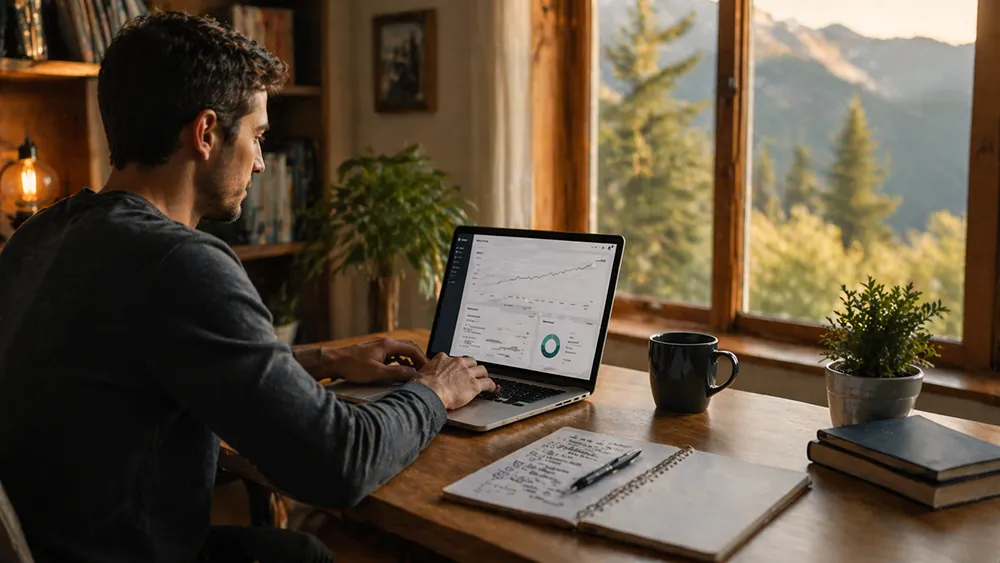
The dream of working for yourself isn’t new, but the path to getting there has completely transformed. A decade ago, starting a small business meant signing a lease, taking out loans, and hoping enough foot traffic would walk through your door.
Today, you can launch a small business online from your kitchen table with less than $100, reach customers on the other side of the world by Friday, and design a life that actually fits around the things you care about.
Are You Ready to Get Started?
If you’ve been quietly thinking about making money online, escaping the 9-to-5, or building something of your own, you’re not alone. Millions of people are doing exactly this right now.
The question isn’t whether it’s possible anymore. It’s about doing it in a way that creates genuine freedom rather than just trading one form of burnout for another.
This guide walks through what it actually takes to start a business online, the most viable models for beginners, and how to build something that gives you the lifestyle you’re after, not just a paycheck.
Let’s be clear about a few things first. If you aren’t ready to put some time and money into getting going, you’re not very likely to succeed. The Internet is littered with get-rich-quick schemes, none of which improve your finances or build a foundation to change your life.

Why Starting a Small Business Online Makes More Sense Than Ever
The internet has leveled the playing field in ways that still feel surreal. You no longer need a warehouse to sell products, a storefront to attract customers, or a marketing budget to reach your audience.
What you need is a laptop, an internet connection, and the willingness to learn a few fundamental skills.
Consider what’s changed in the last few years alone. AI tools can help you write, design, and even code. Payment processing is essentially frictionless. Social media platforms hand you free distribution. Cloud-based software means you can run an entire business from anywhere for less than what most people spend on coffee each month.
More importantly, customers have fundamentally shifted how they buy. They research online, they trust small creators over big brands, and they’re increasingly happy to purchase from a solo entrepreneur, a.k.a. a solopreneur, rather than a corporation. This is genuinely unprecedented, and it means the opportunity to build an online business is wider than at any previous moment in history.
You truly are at a point where you can decide whether you want to continue working for others, lining their pockets, or work for yourself and become financially independent.
But here’s what most articles won’t tell you: the low barrier to entry is both the opportunity and the challenge.
Because anyone can start, competition is everywhere. Success now depends less on having a brilliant idea and more on execution, consistency, and building something genuinely useful for a specific group of people.

Defining What Lifestyle Freedom Actually Means to You
Before you pick a business model, do yourself a favor and get specific about what you actually want. “Lifestyle freedom” gets thrown around constantly, but it means radically different things to different people.
It may be more accurate to think of what you are trying to achieve. For many people, flexibility in life is the true goal. Not being tied to someone else’s timetable, attitudes, and goals. The ability to define your own life can be the most liberating experience!
What is it for you?
For some, it’s geographic freedom, the ability to work from Bali in January and the mountains in July. For others, it’s time flexibility, meaning they can pick their kids up from school, work when they’re most productive, and take a Tuesday off without asking permission.
For many, it’s simply escaping from having a boss, knowing that the work you do benefits you directly instead of someone else’s bottom line.
Some people want to build a small profitable online business that pulls in $5,000 a month and lets them work 15 hours a week. Others want to build something that grows into a seven-figure operation. Both are legitimate, but they require very different approaches. If you try to build both simultaneously, you’ll end up with neither.
Spend real time on this. Write down what your ideal Tuesday looks like a year from now. Figure out how much money you actually need, not the vague “more” we all default to. Think about how much you want to work, what kinds of tasks energize you, and which ones drain you. This clarity becomes the filter for every decision you make moving forward.

The Most Viable Small Business Online Models for Beginners
Not all online businesses are created equal. Some are genuinely accessible to beginners, while others require skills or capital that most people don’t have starting out.
Here are the models that consistently work for people looking to start a small business online and eventually build the flexibility they truly desire.
Service-based businesses are typically the fastest path to your first dollar online. If you can write, design, edit video, manage social media accounts, do bookkeeping, provide virtual assistance, or offer consulting in an area where you have expertise, you can start this week. The beauty of service businesses is that they require almost no upfront investment and let you start making money online quickly. The downside is that your income is tied directly to your time, so you’ll eventually want to productize, raise rates, or transition to something more scalable.
Digital products include things like online courses, ebooks, templates, printables, stock photos, software tools, and downloadable resources. They take longer to create and launch, but once they’re done, they can generate revenue around the clock without you having to do any more work. A well-made digital product in the right niche is one of the closest things to passive income, though “passive” always requires ongoing marketing.
E-commerce and dropshipping let you sell physical products without holding inventory. Print-on-demand services let you design t-shirts, mugs, and art that only get produced when someone orders. Traditional dropshipping has become more competitive and harder to make work profitably, but niche product stores that solve specific problems can still do well.
Content creation and affiliate marketing involve building an audience around a topic you care about, then monetizing through ads, sponsorships, affiliate commissions, or your own products. This is a longer game, often requiring a year or two before meaningful income, but the upside is substantial, and the flexibility is genuine once it’s up and running. As you build out, it is useful to understand the definition of affiliate marketing so you don’t get pulled into schemes sometimes pitched as affiliate marketing.
Freelance platforms and marketplaces like Upwork, Fiverr, and specialized industry sites let you find clients without having to do your own marketing initially. They take a cut, and the competition is fierce, but they’re a reasonable starting point to build case studies and client testimonials.
The best model for you depends on your current skills, how much time you can invest, how quickly you need income, and what kind of work you actually enjoy. Most successful online entrepreneurs end up combining two or three of these over time.

How to Actually Choose Your Niche and Offer
Niche selection is where most aspiring online business owners get stuck. They spend months agonizing over the “perfect” niche, reading endless articles, watching YouTube videos, and ultimately never starting. Here’s a more practical approach.
Start with the intersection of three things: something you have at least some knowledge about or can quickly learn, something people are actively spending money on, and something you can sustain interest in for at least two years. You don’t need to be passionate about your niche in some grand spiritual sense. You just need to be curious enough to keep learning and engaged enough to keep showing up.
Specificity is your friend. “Fitness” is not a niche. “Strength training for women over forty who work desk jobs” is a niche. The tighter you can define who you serve and what problem you solve, the easier everything else gets. Marketing becomes clearer, your content resonates more, and customers find you more easily because you’re speaking directly to them rather than shouting into a crowd.
Validate your idea before you build anything elaborate. Talk to actual potential customers. Post in relevant online communities. Offer your service at a discount to a few early clients. Create a simple landing page and see if anyone signs up for a waitlist. You want evidence that real people with real credit cards are interested in what you’re planning to offer, not just polite encouragement from friends and family.
Setting Up the Foundation Without Overcomplicating It
One of the biggest traps for new online business owners is spending three months building the perfect website, logo, and brand before ever talking to a customer. Resist this. The foundation you need to start is genuinely minimal.
You need a simple way for people to find you and learn what you do. This can be a basic website built on a platform like Squarespace, a free Carrd page, or even just a well-optimized social media profile in the beginning. You need a way to accept payments, which Stripe, PayPal, or platform-specific solutions handle easily. You need a way to deliver what you’re selling, whether that’s a service agreement, a digital download system, or a shipping process. You need a basic way to communicate with customers, typically email and one or two social platforms.
That’s genuinely it for the first six months. Skip the fancy CRM, the elaborate email funnels, the custom-coded website, and the professional videography. These things matter eventually, but using them as an excuse to delay launching just keeps you stuck.
On the legal and financial side, register your business appropriately in your jurisdiction, open a separate bank account so you don’t mix personal and business finances, and track your income and expenses from day one. In the United States, a basic LLC is usually sufficient for most small online businesses starting out. Talk to an accountant once you’re bringing in meaningful revenue, not before.

Marketing Your Small Business Online Without Losing Your Mind
Marketing is where most small business online owners feel overwhelmed. There are seemingly infinite platforms, strategies, and gurus promising that their approach is the only one that works. Here’s the truth: you don’t need to be everywhere. You need to be effective in one or two places where your ideal customers actually spend time.
Pick one primary channel and go deep. If you’re selling B2B services, LinkedIn might be your home base. If you’re targeting a younger consumer audience, TikTok or Instagram probably makes more sense. If you’re in a more information-dense niche, a blog or YouTube channel can build trust over time. Podcasts work beautifully for certain audiences. Email lists, despite being old technology, remain one of the highest-converting channels in existence.
Whatever you choose, commit to consistency over perfection. Posting three times a week for a year beats posting daily for a month and burning out. Showing up reliably is what builds trust, and trust is what ultimately converts strangers into customers.
Don’t neglect the fundamentals of search. Google still drives enormous amounts of buying intent traffic, and ranking for even a handful of relevant keywords can generate customers for years. Write genuinely helpful content that answers questions your ideal customer is actually asking. This article exists partly because someone searched for something like it.
Finally, remember that word of mouth remains the most powerful marketing in existence. Deliver excellent work, follow up with customers, and make it easy for them to refer others. A small online business with a reputation for being exceptional doesn’t need massive marketing budgets.

The Real Path to Making Money Online (And Keeping More of It)
Let’s talk honestly about making money online, because there’s a lot of nonsense floating around on this topic. Building a small business online to real profitability typically takes longer than most influencers suggest and less time than most skeptics claim.
Your first $1,000 online is often the hardest. Getting to $5,000 a month takes real work but is achievable within six to eighteen months for most motivated people in reasonable niches. Scaling past $10,000 a month requires either raising your prices significantly, building systems and a team, or creating products that scale independently of your time. Focusing on the right tasks as you scale through each of these stages is critical, as is validating your idea before you spend money or significant time.
Focus relentlessly on revenue in the early days. Vanity metrics like followers, subscribers, and website visits feel good but don’t pay bills. As a matter of fact, those vanity metrics can be the reason your online business fails.
A tiny audience that buys beats a massive audience that doesn’t. Track your actual dollars, figure out which activities directly lead to revenue, and do more of those things.
Pay attention to margins and keep overhead low. One of the magical things about starting a small business online is how little it costs to operate compared to traditional businesses. Don’t give that advantage back by subscribing to every tool, hiring contractors too early, or upgrading your setup before the revenue justifies it. Keep expenses lean until your business can clearly afford them.
Reinvest thoughtfully. Early profits should typically go toward things that directly generate more revenue: better tools that save you significant time, outsourcing tasks that don’t require your specific input, or learning skills that increase your earning capacity. Don’t get crazy about spending the moment money starts coming in.

Building a Business That Actually Creates Freedom
Here’s where most articles on this topic fall short. They treat “start a small business online” as the goal, when really it’s just the beginning. The harder and more important work is structuring the business so it actually gives you the lifestyle you wanted in the first place.
It’s genuinely possible to build a small business online that traps you in a worse version of your old job, working longer hours, with more stress, and less security. This happens constantly. Avoiding it requires intentional design from the beginning.
Build systems as you go. Every time you do a task twice, ask yourself if it can be documented, automated, or delegated. Your goal isn’t to be the person doing every job in your business forever. It’s to gradually work yourself out of the tasks that drain you so you can focus on what you’re uniquely good at or simply enjoy more.
Set boundaries that protect your time. Just because you can work from anywhere doesn’t mean you should work everywhere. Create real working hours, even if they’re unconventional. Take actual time off. Say no to work that doesn’t fit your business or your life, even when you’re nervous about turning down money.
Diversify your income streams once you’re stable. Relying on a single platform, a single client, or a single product is fragile. Once your primary income source is reliable, gradually add others. This protects you from algorithm changes, market shifts, and the general unpredictability of the internet. Read my post on deploying a reseller hosting account for my various projects, which includes a little confession on how I made things to complicated for myself.
Starting This Week: Your Actual Next Steps
If you’ve read this far and you’re still thinking about starting a small business online, the best thing you can do is move from reading to doing. Pick one business model that resonates with your situation. Narrow down to a specific niche and offer. Create the simplest possible online presence, even if it’s just a basic profile explaining what you do. Reach out to five potential customers or post one piece of content that genuinely helps someone.
Do this before you feel ready, because you won’t feel ready. The people who build successful small online businesses aren’t the ones with the best ideas or the most capital. They’re the ones who started when everyone else was still reading articles like this one, and kept going when it got hard.
The opportunity is genuinely real. The path exists. The tools are accessible. The only missing piece is the decision to actually start and the discipline to keep showing up. If making money online and building real flexibility matter enough to you, there’s never been a better time to begin.
Your future self, the one who has the freedom, the income, and the life on your own terms, is built by the decisions you make this week. Start small. Start imperfect. But start.