
Affiliate marketing sounds almost too good to be true when you first hear about it. You recommend products you genuinely like, someone buys through your link, and a company pays you a commission. No inventory. No customer service. No shipping headaches. Just you, a laptop, and an internet connection. The reality is a little more nuanced. Affiliate marketing is a legitimate way to build an income online and create a lifestyle business, but it’s not a lottery ticket. The creators earning six and seven figures got there by treating it like a real business, not a get-rich-quick scheme. The good news is that your first $1,000 is absolutely achievable if you follow a proven path and stay consistent. This guide walks you through that path step by step. By the end, you’ll know exactly what to do on Monday morning to start building your first affiliate income stream.
What Affiliate Marketing Actually Is
Before we get into tactics, let’s make sure we’re on the same page about the business model and definition of affiliate marketing.
Affiliate marketing is a performance-based arrangement where a company pays you a commission for driving sales, leads, or other specified actions through unique tracking links you share. When someone clicks your link and completes the desired action, you get paid. Commission rates vary wildly, from around 1% for physical products on Amazon to 30-50% or more for digital products, software subscriptions, and online courses.
The key word is “performance.” You only earn when results happen. This means there’s essentially no barrier to entry, but it also means you have to actually drive results to see any money. Nobody is going to hand you a paycheck just for signing up to an affiliate program.
Three parties make the whole system work. The merchant creates the product. The affiliate (that’s you) promotes it. The customer buys the product or service through your affiliate link. A tracking network or platform sits in the middle, ensuring everyone is credited and paid correctly.
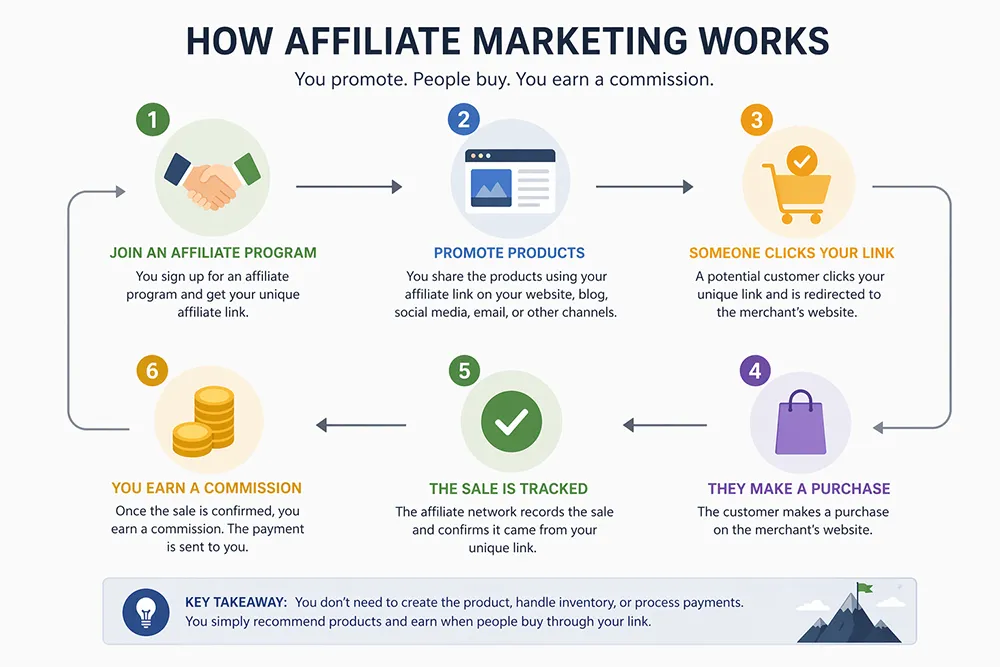
How Affiliate Marketing Actually Works
When you join an affiliate program, you receive a unique link with a tracking code embedded in it. When someone clicks that link, a cookie gets placed in their browser. If they buy the product within the cookie window, typically 24 hours to 90 days, depending on the program, you get credited with the sale and earn affiliate commissions.
Commissions are usually paid monthly, often with a minimum payout threshold of $50 or $100. Some programs pay once and done on each sale. Others, especially for software and memberships, pay recurring commissions as long as the customer stays subscribed. Recurring commissions are gold because your earnings compound over time, even if you stop adding new customers.
Now that you understand the mechanics, let’s build your roadmap, or as Shea prefers to say, “Your Trailmap!”
Step 1: Choose a Niche You Can Commit To
The single biggest affiliate marketing mistake novice marketers make is trying to appeal to everyone. A blog about “making money” or “health tips” competes with millions of other sites saying the same generic things. You have little to no chance of standing out.
Instead, pick a specific niche where you can credibly help a specific person solve a specific problem, and your affiliate marketing efforts will pay off. The best niches for beginners sit at the intersection of three things: something you’re genuinely interested in, something people actively spend money on, and something where you have at least a little real experience or willingness to develop some.
Profitable niches tend to cluster around a few themes.
Personal Finance
Personal finance works because money anxiety is universal, and financial products pay well. Credit cards, brokerages, robo-advisors, budgeting apps, tax software, and loan refinancing companies all run generous affiliate programs, often paying $50 to $200 or more per signup.
Readers in this niche are highly motivated because the stakes are concrete: saving on interest, earning travel rewards, growing retirement accounts, or digging out of debt. If you can help someone feel more in control of their money, they’ll trust your recommendations and act on them.
Just be careful to stay on the right side of financial regulations in your region and always disclose your affiliate relationships clearly.
Relationships and Dating
Relationships and dating work because the emotional stakes are high, and people will pay real money for even a small edge. Dating app subscriptions, relationship coaching programs, courses on communication, and books on attachment styles all convert well because the pain points — loneliness, heartbreak, conflict, dating fatigue — are intensely personal.
Content in this niche performs best when it feels like advice from someone who genuinely understands the struggle rather than a detached expert talking down to the reader. Promoting affiliate products here requires extra care: your recommendations are touching sensitive parts of people’s lives, and anything that feels manipulative or opportunistic will destroy trust instantly.
Hobbies With Expensive Gear
Hobbies with expensive gear, like photography, woodworking, cycling, or home improvement, work because enthusiasts love researching and buying new equipment. These audiences are a dream for affiliates. They spend hours watching reviews, comparing specs, and reading forum threads before they make a purchase, which means your in-depth comparison post or honest review can be the final nudge that tips them toward buying.
Enthusiasts also tend to upgrade repeatedly as their skills grow, so a single reader can generate commissions for years.
The trick is credibility: you need to actually know the hobby well enough to spot the differences that matter, or readers will sense the gap immediately.
Career and Skill Development
Career and skill development works because people invest in courses and tools that promise better jobs or higher incomes. Online courses, certification programs, resume services, coaching, project management software, and productivity tools all fit here, and many pay excellent commissions — especially digital products and SaaS tools with recurring revenue.
The underlying motivation is powerful: your readers believe the right investment today will help them earn money for years to come, so the perceived return on a $200 course or a $50/month subscription feels small relative to the upside. Promoting products in this niche works best when you share specific outcomes — the exact skills a course taught you, the jobs readers landed, the raises they negotiated — because proof of results is what converts hesitant buyers into confident ones.
Narrow the Niche to Make Affiliate Marketing Work
Rather than choosing “fitness,” choose “strength training for women over 40.” Rather than “personal finance,” choose “debt payoff strategies for young families.” The narrower your focus, the easier it is to become the go-to resource for your exact audience, and the higher your conversion rates will be.
Ask yourself: Can I talk about this topic for the next two years without getting bored? If the answer is no, keep looking. Burnout is the number one killer of affiliate sites, and you won’t push through the slow early months unless you genuinely care about what you’re writing or filming.
Step 2: Pick Your Platform to Start Affiliate Marketing
You need a place to publish content and build an audience. Each platform has different strengths, learning curves, and revenue timelines.
Your platform choice is essentially your entry point into the broader world of digital marketing, and that decision shapes everything downstream: the skills you’ll develop, the tools you’ll need, and how quickly you can expect to see results. Some channels reward patience and compound slowly over time, while others can produce traction in weeks but demand constant feeding. There’s no universally “best” option, only the one that best fits your strengths, your schedule, and the kind of content you can genuinely see yourself creating for the next year or two.
A Blog for Making Money Online
A blog or website gives you the most control and the longest-lasting results. Unlike social platforms, where a single algorithm change or account suspension can wipe out years of work overnight, a site you own is a real asset. You decide the design, monetization strategy, email capture, and direction of every piece of content. That ownership is one of the biggest reasons blogging remains a foundational channel for beginners and veterans alike.
Articles optimized for search engines can drive traffic for years with zero ongoing effort. A well-researched post targeting the right keyword can sit on page one of Google and quietly generate clicks, email signups, and affiliate commissions for months or even years after you hit publish. This is the magic of content marketing done right: you do the work once, following a solid checklist, and the asset keeps paying you.
Compare that to social media, where a post has a shelf life of hours, and the appeal becomes obvious. It’s also why so many successful affiliate marketers build their business on a blog first and treat every other channel as a supporting player.
The downside is that search engine marketing (SEO) takes six to twelve months to start producing meaningful traffic, and that slow start is when most newbie solopreneurs quit. You’ll publish your first ten posts, see almost no traffic, and wonder if you’re doing something wrong. Usually, you’re not. Google simply takes time to trust a new site, and most rankings climb gradually rather than appearing overnight. The affiliates who break through are the ones who keep publishing during those quiet early months, trusting that the compounding will eventually kick in.
On top of the patience requirement, there’s a modest technical learning curve. You’ll need to learn the basics of WordPress (or a similar platform), hosting, domain setup, and on-page SEO fundamentals like title tags, meta descriptions, internal linking, and content structure. None of it is genuinely hard, and countless free tutorials will walk you through every step, but it’s a handful of new skills to pick up before you’re fully up and running. Budget a weekend to get your site live and another few hours spread across your first month to get comfortable with the publishing workflow.
Long-Form Video Marketing
YouTube is extraordinary for affiliate marketing because video builds trust fast, and viewers often watch with buying intent. Product reviews, tutorials, and comparisons convert especially well. The tradeoff is that creating quality video content takes more time per piece than writing, and the learning curve for editing and presenting on camera is real.
Digital Push Marketing
Newsletters and email marketing have exploded thanks to platforms like Substack, Beehiiv, and ConvertKit. Email audiences are yours in a way that social followers are not, and email converts dramatically better than social media. You still need traffic from somewhere to build the list, though.
Short-Form Social Media Marketing
Short-form video platforms like TikTok, Instagram Reels, and YouTube Shorts can drive fast growth, but they’re brutal for direct affiliate sales because you can’t usually put clickable links in content. They work best as a top-of-funnel to drive people to your newsletter, blog, or YouTube channel.
Pick one platform to start. Exactly one. Beginners who try to be everywhere end up being nowhere. You can expand later once your first channel is producing consistent results.
Step 3: Find the Right Affiliate Marketing Programs
With a niche and platform selected, it’s time to identify what you’ll actually promote. You have several options, and most successful affiliates use a mix.
Affiliate networks aggregate thousands of programs in one place. Amazon Associates is the most famous and easiest to join, though commission rates are low, typically 1-4%. ShareASale, Impact, CJ Affiliate, Awin, and Rakuten host programs from major brands across nearly every category. Signing up for these networks and becoming an affiliate gives you access to a huge catalog you can search through.
Direct affiliate programs often pay better than network programs because the company isn’t paying middleman fees. Many software companies, course creators, and online service businesses run their own programs. Search for “[product name] affiliate program,” and you’ll usually find out quickly whether one exists.
Digital products deserve special mention because they typically pay 30-50% commissions, making them a lucrative choice for any affiliate marketing business, and sometimes offer recurring revenue. Platforms like ClickBank, Digistore24, PartnerStack, and Gumroad are full of courses, software, and digital tools looking for affiliates. Do your homework on quality here, because the digital product world has its share of low-quality products with flashy sales pages.
When evaluating programs, look at more than just the commission rate. A 50% commission on a product nobody wants is worth zero. Check the cookie duration, the average order value, the refund rate (if disclosed), and, most importantly, whether you’d actually recommend the product to a friend. Your reputation is your most valuable asset. Protect it.
As a rule of thumb, only promote things you’ve used, would use, or have carefully researched. Your audience can smell inauthenticity from a mile away, and one bad recommendation can erase the trust you’ve spent months building. This is a great rule for affiliate marketing for beginners.
Step 4: Create Content That Solves Real Problems
Here’s where most beginners go wrong: they create content about products rather than about problems.
Think about how you actually buy things online. You rarely wake up wanting to buy a specific blender. You wake up frustrated because your smoothies are chunky, you want to start meal prepping, or your old blender has died. You search for solutions, and somewhere along the way, a blender gets recommended.
Your job as an affiliate is to be the helpful voice who meets people when they have a problem. That means writing and filming content that answers real questions, solves real frustrations, and provides real value, with product recommendations woven in naturally, particularly focusing on the type of affiliate products that resonate with your audience.
Four types of content consistently drive affiliate revenue.
- Tutorials and how-to guides attract people actively trying to do something, and you can recommend the tools that make the job easier.
- Product reviews attract people who are already considering a purchase and are just looking for confirmation or an alternative.
- Comparison posts (product A versus product B) attract people at the very end of the buying journey, so they convert at extremely high rates.
- Best-of roundups (best running shoes for flat feet, best CRM for freelancers) are evergreen workhorses that can generate commissions for years.
Whatever format you choose, aim to be more helpful than the competition. Actually use the products when possible. Include original photos or screenshots. Share what you didn’t like, not just what you loved. Address the objections your reader is privately worrying about. This kind of content is harder to create than generic filler, but it converts five to ten times better and builds a real audience.
Aim for a cadence you can sustain. One excellent blog post per week will beat five mediocre ones. One thoughtful YouTube video every two weeks will beat daily uploads you can’t keep up with, particularly if it promotes a high-quality product. Consistency over intensity always wins for affiliate marketing strategies.
Step 5: Drive Traffic to Your Content Using Digital Marketing
Content without an audience is a diary. You need to get eyeballs on what you create, and there are three main ways to do it. The more you work at each of these, the better you become at online marketing and developing marketing strategies that work.
Search engine optimization (SEO) is the most reliable long-term traffic source for blogs and YouTube. By researching what your target audience searches for and creating content that better answers those queries, you can rank on Google or YouTube and receive free traffic indefinitely. Tools like Ahrefs, Semrush, and Ubersuggest help you find keywords with decent search volume and low competition. The tradeoff is time. Expect six months before SEO starts paying off, and twelve before it really kicks in.
Social media can jump-start your audience much faster, especially on platforms that prioritize discoverability, such as TikTok, Pinterest, and YouTube Shorts. Pinterest is particularly underrated for affiliate marketers because it functions more like a visual search engine than a social network, and it drives long-lasting traffic to blog posts. The downside of social media is volatility. Algorithms change, accounts get banned, and platforms rise and fall.
Paid advertising can accelerate results in your affiliate marketing work if you know what you’re doing. but it’s a terrible place to start. You’ll burn cash learning lessons that free traffic would have taught you for nothing. Save paid traffic for after you have a proven piece of content that converts well organically, especially if you want to maximize your affiliate marketing commissions.
Whatever traffic source you choose, track what’s working. Google Analytics, your platform’s built-in stats, and the click data from your affiliate programs will tell you which content is actually producing revenue. Most of your earnings from your affiliate marketing program will eventually come from a small handful of pieces. Your job is to find them and then create more like them. Affiliate marketing for beginners can seem slow and challenging, but the more time you take to educate yourself, the more likely you are to succeed.
Step 6: Build Trust and Convert to Earn Money
Getting traffic is only half the equation. The other half is turning visitors into buyers, and that comes down to trust.
While affiliate marketing allows you to make money, real trust and long-term income are built through consistency, honesty, and genuinely useful information. A few specific things accelerate it. Disclose your affiliate relationships clearly, not just because the FTC requires it, but because being upfront actually increases conversions.
Readers appreciate knowing the rules of the game. Share your own experiences, mistakes, and genuine opinions, including criticism of products you’re promoting. An all-positive review of an affiliate product reads like an advertisement, which can deter potential buyers. A balanced review reads like advice from a friend.
Place your affiliate links strategically rather than scattering them everywhere. Too many links look desperate and spammy. A few well-placed recommendations in context convert better than a wall of links.
Start building an email list from day one. Offer a simple freebie, a checklist, a mini-guide, a spreadsheet template, whatever fits your niche, in exchange for an email address. Your email list is the single highest-converting asset you’ll build, because subscribers have already demonstrated interest and given you direct access to their inbox. When you launch new content or recommend a product, your list will drive more revenue than your traffic numbers would suggest.
Step 7: Track, Test, and Scale
Once you have some content driving some traffic and some commissions, the game shifts. Instead of creating more stuff, you start optimizing what you already have.
Look at your analytics monthly. Which pages get the most traffic? Which ones generate the most commissions? These aren’t always the same. A page getting 500 visitors a month might out-earn a page getting 5,000, because its visitors are closer to buying.
Double down on what’s working. If your comparison posts convert well, write more comparison posts. If a specific affiliate program produces outsized results, see if you can create additional content for related products from that merchant. Update your best-performing posts regularly with fresh information, new screenshots, and updated product picks. Google rewards freshness, and readers reward accuracy.
Only after you have one channel working consistently should you expand. Add a YouTube channel to your blog. Start a newsletter to complement your YouTube channel. Test a new niche only after your first one is humming along on autopilot to ensure your affiliate marketing business remains stable.
Common Mistakes That Stall Beginners
A few predictable mistakes derail most newcomers before they hit their first $1,000. Being aware of them gives you a huge advantage and makes you less likely to launch an online business that fails.
- Quitting too early is the leading cause of death. Most affiliate sites produce almost nothing for the first three to six months and then start compounding. If you quit at month four, you never see the payoff.
- Promoting too many affiliate products dilutes your focus and confuses your audience. Better to be the trusted expert on five products than the shallow reviewer of fifty.
- Ignoring email is a massive missed opportunity. Every dollar spent on email typically returns $30 to $40 for online businesses, including affiliate sites.
- Chasing trends instead of building a focused site produces a Frankenstein of unrelated content that ranks for nothing and converts for no one. Pick a niche and go deep, especially if you want to make money online.
- Not actually using affiliate products leads to generic reviews that read like you rewrote the sales page. Readers can tell, and they click away.
Another mistake is failing to treat your website like a business. You will go through various stages of growth. At each stage, you need to focus on specific tasks that will help you move forward.

A Realistic Timeline to Your First $1,000
Let’s set honest expectations. Nobody makes $1,000 in their first week of affiliate marketing, especially if they are just starting with affiliate marketing without an existing audience or platform. But a motivated newbie marketer following this roadmap can realistically expect something like the following.
Months one through three are your foundation phase. You pick your niche, set up your platform, join affiliate programs, and publish your first fifteen to twenty pieces of solid content. Revenue during this phase is usually zero to a few dollars. This is normal. You’re not making money yet, but starting an affiliate marketing business can change that over time. You’re building the asset that will make money later.
Months four through six are when things start moving. Your first content starts ranking or getting recommended. You begin seeing small commissions, maybe $50 to $200 per month. Don’t celebrate or despair. Just keep publishing.
Months seven through twelve are when the magic often happens. The content you created months ago starts compounding, your email list grows, and monthly revenue typically climbs into the hundreds or low thousands. Your first $1,000 month usually falls within this window for dedicated beginners.
Some people get there faster. Some take longer. The variable isn’t talent. It’s consistency. The affiliates who make it are the ones who publish their twentieth piece of content when their first nineteen have earned them nothing, because they trust the process and the process works.
Your Next Move in Affiliate Marketing for Beginners
Is it time to begin your affiliate marketing journey? Affiliate marketing rewards patient, consistent, genuinely helpful creators. It punishes shortcuts, scams, and spray-and-pray tactics. If you’re willing to build real value over real time, your first $1,000 is not just possible, it’s nearly inevitable on your affiliate marketing journey.
Your next step isn’t to research more about affiliate marketing for beginners. It’s to decide. Pick your niche today. Pick your platform today. Sign up for one or two affiliate programs this week and get your affiliate links.
Publish your first piece of content within the next seven days and promote your affiliate products or services, even if it’s imperfect. Perfection is the enemy of publishing, and unpublished work helps no one, including you.
The creators earning life-changing income from affiliate marketing started exactly where you are right now. The difference is that they started. Then they kept going. You can do the same. So, lace up your boots and hit the trail as you work toward the life you deserve.

If you’re interested in diving deeper into how to use affiliate marketing, enroll in my Building a Profitable Online Business Video Series.
Frequently Asked Questions
How much money can a new affiliate marketer realistically expect to earn in the first year?
Honest answer: Most new affiliate marketers earn very little in their first three to six months and somewhere between a few hundred and a few thousand dollars per month by the end of year one.
A smaller group breaks through to $5,000+ months within twelve months, usually because they already had relevant skills (writing, video, audience-building) or dedicated significant time each week.
The affiliate dashboard you’ll be refreshing obsessively in month two will look discouragingly empty, and that’s normal — affiliate income tends to compound slowly, then suddenly. The biggest predictor of first-year earnings isn’t talent or niche; it’s how many pieces of quality content you actually publish and how long you stick with it before quitting.
What type of affiliate program is best for new marketers — high-ticket, low-ticket, or recurring commission?
Each has tradeoffs, and the best choice depends on your traffic source and audience. Low-ticket programs like Amazon Associates convert easily because buyers trust the platform, but Amazon affiliate commissions are small, so you need volume.
High-ticket affiliate marketing offers (think $500+ courses or premium software) pay far more per sale but require more trust-building and longer content to convert.
Recurring commission programs, especially for SaaS tools, are often the sweet spot because a single customer can pay you monthly for years. These affiliate offers are gold!
Most successful affiliate marketers eventually promote a mix: low-ticket products to warm up new readers, then higher-value recurring programs once trust is established. The types of affiliate marketing continue to grow, so building strong affiliate partnerships and learning new marketing tools can help drive traffic to your affiliate offers.
Do I need a large audience before I start promoting and executing my affiliate marketing strategies?
No, and waiting until you have one is a common mistake. You can include your unique affiliate link in your content from day one, as long as you clearly disclose the relationship. Even a tiny audience of 100 engaged readers who trust you will outperform 10,000 casual followers who don’t. The goal isn’t raw audience size — it’s audience fit. A blog post targeting the right search query can start generating clicks and commissions long before you’d consider yourself “established.” Start recommending products you genuinely use and believe in immediately; you’ll learn far more from your first real conversion than from another month of preparing.
What strategies actually work for affiliates in 2026, and which ones are a waste of time?
What works: search-optimized long-form content, YouTube reviews and tutorials, email newsletters, and Pinterest for visual niches. What mostly wastes time for new online entrepreneurs: trying to go viral on every social platform at once, running paid ads before you understand conversion rates, and churning out low-effort AI content hoping to scale fast.
The fundamentals of profitable affiliate marketing haven’t really changed — genuinely helpful content, built around real search intent, distributed through channels you can sustain. The specific tactics evolve, but the principles don’t. Pick one or two strategies that fit your strengths and commit to them for at least six months before evaluating.
The one strategy that many don’t realize is critically important for making money with affiliate marketing is getting started. For every 100 people who study affiliate marketing methods, only a few go beyond learning about it. So take that first critical step and build your own successful affiliate marketing business.
What marketing skills should I focus on developing first to gain success as an affiliate?
While you should always be working to improve your marketing capabilities as you become an affiliate marketer, the four core marketing skills drive almost all affiliate results:
- Writing clearly
- Understanding search intent
- Basic SEO,
- Email copywriting.
If you can explain a product’s benefits in plain language, figure out what your reader is actually trying to accomplish, get your content found on Google, and write emails people want to open, you’ll outperform most of your competition. Affiliate marketing for beginners is less about flash and more about solid, useful content.
Video editing and graphic design are useful additions depending on your platform, but they’re secondary. The good news is that all of these skills improve with practice, and every piece of content you publish is a rep. You don’t need to master them before you start — you master them by starting.
Should I promote multiple products from different niches or focus on one?
Focus on one niche, at least at the beginning. New marketers often hop between niches and different affiliate programs, hoping to find one that “works,” but the problem is almost never the niche — it’s the lack of depth and consistency.
When you concentrate on a single niche, your content starts to interlink, your authority compounds, and your email list becomes cohesive enough that a single recommendation can produce dozens of sales.
Once you have one site or channel producing a reliable income, you can absolutely expand into a second niche if you want. But chasing multiple niches simultaneously as a newbie almost guarantees none will reach critical mass.
Once you do hit that critical mass, be sure to read my post on hosting your sites with a reseller account.
Some affiliate marketers discover that they can augment their affiliate income with their own products. Be sure to validate your idea before you head down that path.
How do I know if my affiliate links are actually working?
Every affiliate program provides an affiliate dashboard where you can track clicks, conversions, commission amounts, and payout status. Check it weekly, not hourly — obsessively refreshing it early on will only frustrate you. Honestly, affiliate marketing is one way to drive yourself crazy if you don’t practice patience, especially as you learn the ins and outs of affiliate marketing.
More importantly, use a link management tool (like Pretty Links for WordPress or a simple spreadsheet) to track which pieces of content generate which clicks. You’ll usually find that 20% of your content produces 80% of your revenue, and knowing exactly which pages those are tells you where to double down.
If you’re getting clicks but no conversions, the issue is usually the match between your content’s audience and the offer, not the link itself.