
Most “online business growth” articles read like they were written by someone who has never actually grown a business. The advice reads like a lame to-do list:
- Post more on social media.
- Niche down.
- Hustle harder.
The advice is so generic it could apply to a bakery, a SaaS company, a competitive roller derby team, or a dog-walking app — which means it doesn’t really apply to any of them.
This article is different in two ways. First, the tips are organized by stage, because what grows a $500/month side project is the opposite of what grows a $50,000/month successful online business. Second, every tip here has a tradeoff. Growth isn’t free — it costs time, money, energy, or optionality, and pretending otherwise is how solopreneurs end up burned out with nothing to show for it.
If you’re looking for effective online business growth tips that go beyond surface-level advice, the next 3,000 words are designed to help you pick the right 2 or 3 moves for where you actually are right now — and ignore the rest until you need them.
Why Most Growth Advice Fails Solopreneurs
Before the tips, a quick reality check. The reason most growth content doesn’t work isn’t that the advice is wrong — it’s because it’s applied at the wrong stage. Hiring a virtual assistant when you don’t have a repeatable offer is a waste of money. Running paid ads when your conversion rate is broken is just paying to lose faster. Building a complex automation funnel before you’ve validated your idea or talked to 10 real customers is procrastination dressed up as productivity.
The framework below sorts every tip into the stage where it actually works. Find your stage, focus there, and resist the urge to skip ahead. Becoming a successful entrepreneur is about doing everything. It’s about focusing and creating leverage.
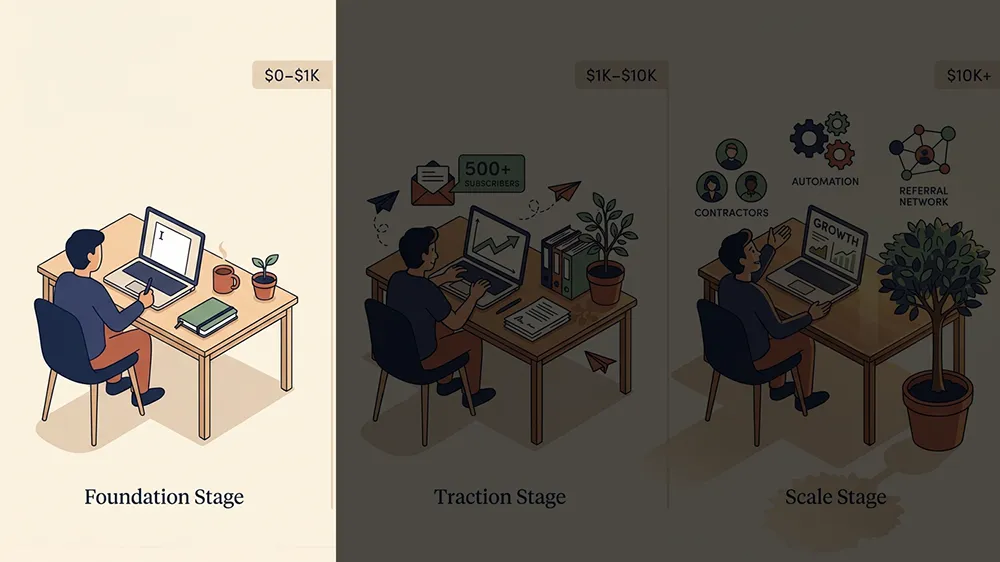
Foundation Stage: Tips for Businesses Earning $0–$1,000/Month
At this stage, your job is not to optimize. Your job is to find out whether anyone actually wants what you’re selling. Everything else is a distraction.
1. Talk to 10 Real Customers Before You Build Anything Else
Analytics lie at low volume. Ten customer conversations with your target audience will teach you more about your market than 10,000 page views ever will. Ask what they tried before, what frustrated them, and what they’d happily pay to solve. The patterns you hear become your offer, your copy, and your brand voice — for free.
The tradeoff: it feels slow and uncomfortable. Do it anyway.
2. Pick One Traffic Source and Go Deep
Spreading attention across Instagram, TikTok, YouTube, a blog, a podcast, and an email list is the single most common reason early online businesses stall. Each platform has its own learning curve, and splitting your effort six ways means you never get good at any of them.
Pick one. Go deep for at least six months. Once it’s producing predictably, then add a second. You may discover that it is more strategic to establish yourself in one channel than to chase trends in all of them.
3. Sell Before You Systematize
It is genuinely shocking how many solopreneurs build elaborate Notion dashboards, brand guidelines, logo iterations, CRM platforms, and onboarding sequences before they’ve made a single sale of any of their products or services. Systematization without revenue is procrastination with better aesthetics.
Your minimum viable system at this stage is: a way for people to pay you, and a way for you to deliver. That’s it.
4. Define Your Minimum Viable Offer
What is the smallest, simplest thing someone will pay you for today? Not the dream product. Not the membership site with five tiers. The thing you could sell by Friday. Start there. Use the revenue to fund the bigger version later.
5. Track One Metric Obsessively
At this stage, vanity metrics will kill you. Followers don’t pay rent. The right metric is almost always either email subscribers or paying customers. Pick one and check it weekly. Ignore everything else until that number consistently moves in the right direction. This will ensure you focus on what will actually boost your business beyond just an idea.
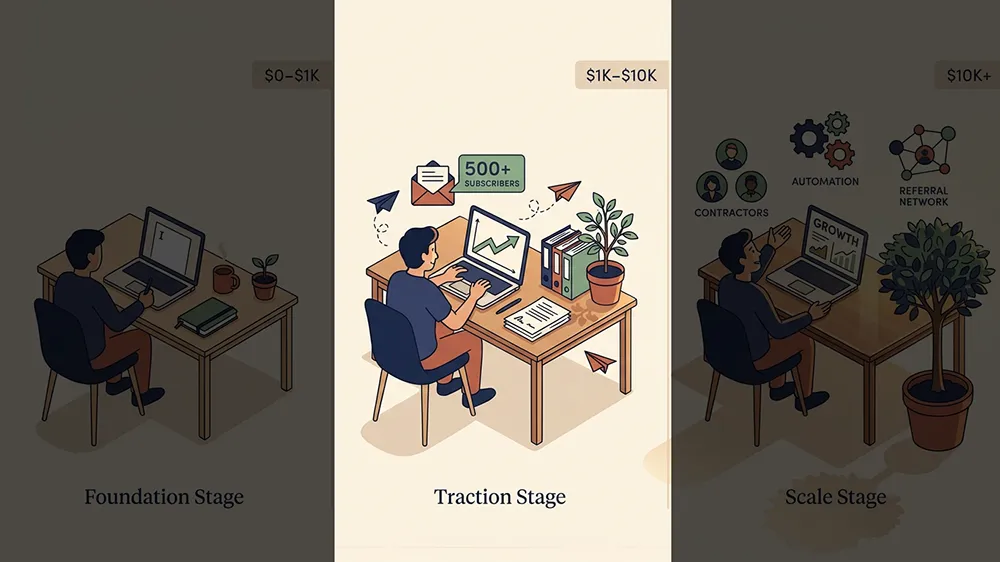
Traction Stage: Tips for Businesses Earning $1,000–$10,000/Month
You’ve proven people will pay. Now the goal shifts: making the thing that worked once work consistently. This is where most solopreneurs plateau because the skills that get you to $1K/month are not the same as those that get you to $10K/month.
6. Document Every Workflow You Do Twice
The first time you do something, just do it. The second time, document it as you go. The third time, you should follow — or improve — the documentation. This habit becomes your operations manual, your future hires’ onboarding, and the foundation of every system you’ll build later.
7. Build an Email Marketing List Before You “Need” One
I cannot overstate this. Email is the single highest-leverage growth asset an online business can own, and it takes 12–18 months to build a meaningful one. If you wait until you “need” a list to start building it, you’re already two years late.
A simple lead magnet, a one-form opt-in on your site, and a weekly email is enough to start. The compounding kicks in around subscriber 500 and gets serious around 2,000. Effective online business growth tips almost always include this one — and there’s a reason.
8. Raise Your Prices by 20% and See What Happens
Most solopreneurs are dramatically underpriced, especially in services. A 20% price increase rarely costs you 20% of customers — usually it costs you 5–10%, which means your revenue goes up and your workload goes down. The customers you do lose are typically the most demanding ones.
The tradeoff: it feels terrifying. Do it anyway, and do it on new customers first if that helps you sleep.
Effective Online Business Growth Tips for Building a Content Engine
Content is where many of these stages connect — it’s the layer that compounds over time and quietly drives traffic, trust, and sales while you sleep. The tips in this section apply across stages but matter most once you’ve validated your offer.
9. Create One Pillar Piece of Content Per Month
Forget daily posting. One genuinely excellent piece of content per month — a long article, an in-depth video, a definitive guide — outperforms 30 mediocre ones over a 12-month window. Pillar content earns backlinks, ranks in search, and gets referenced for years. Daily content disappears in 48 hours.
The strategy here is compounding, not chasing. Build assets, not noise. Implement a system and follow a blog SEO best practices checklist to build a digital empire that attracts customers daily. Over time, you’ll discover that you’ve created measurable brand recognition.
10. Use AI to Multiply Your Content Output Without Multiplying Hours
This is one of the biggest shifts of the last two years. The current generation of writing, research, and editing assistants can compress a 10-hour content workflow into 3 hours without sacrificing quality — if you use them as collaborators rather than replacements.
The trap: publishing machine-generated content with no human voice, no original insight, and no personal experience. Search engines and readers can both tell, and both are increasingly punishing it. Use AI for outlines, research, first drafts, repurposing, and editing. Keep the thinking, opinions, and brand voice human so your target market continues to trust your credibility.
11. Audit Your Time Weekly: Revenue-Generating vs. Busywork
Every Friday, look back at where your hours actually went. Tag each block as either revenue-generating (sales calls, content that drives leads, product development, customer outreach) or busywork (inbox triage, tool setup, “research,” tweaking your website). Most solopreneurs are stunned to find they spend less than 30% of their week on revenue work. Move the needle to 60%, and your business will grow even if you do nothing else.
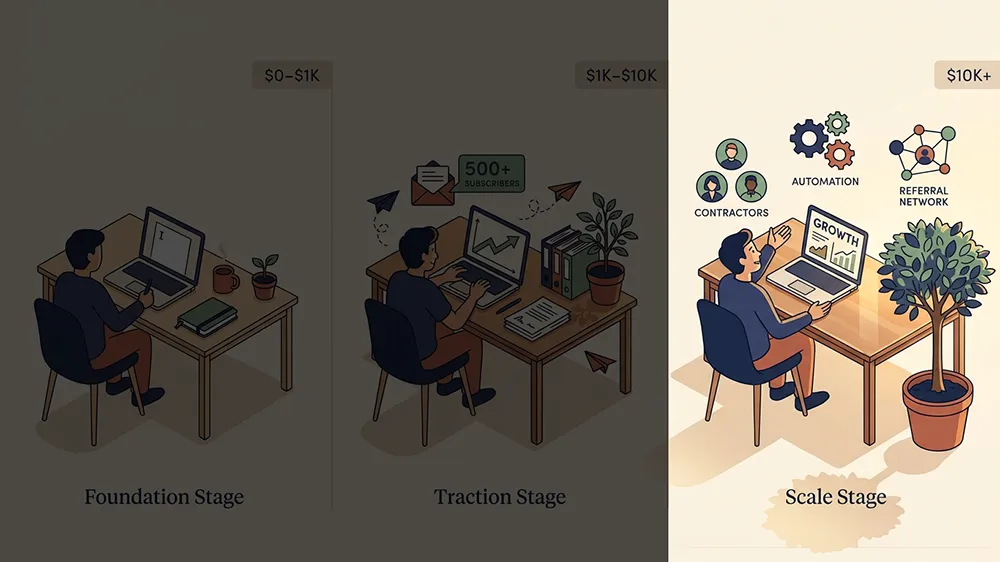
Scale Stage: Tips for Businesses Earning $10,000+/Month
At this stage, the bottleneck stops being demand and starts being you. The goal becomes leverage — getting more output without proportionally more hours. This is also where many lifestyle businesses deliberately choose to stop scaling, and that’s a perfectly valid path.
12. Hire Your First Contractor for the Task You Hate Most
The conventional advice is to hire for “the highest-leverage task.” The better advice is to hire for the task that drains your energy the fastest. The energy you reclaim from offloading the work you hate is worth more than the hourly rate of the work you “should” be delegating. Once that’s working, expand from there.
13. Build a Referral or Affiliate Program
Your existing customers are your most underused growth channel. A simple affiliate program — even a 20% commission on referrals — turns satisfied customers into a distributed sales team you don’t have to manage. The math is almost always favorable: customer acquisition cost drops, lifetime value goes up, and your brand reach extends into networks you couldn’t have accessed any other way.
14. Use AI to Build Operational Leverage Before You Hire
Before you hire your second or third contractor, ask whether an AI workflow could do the same job. Modern automation can now handle customer support triage, lead qualification, content repurposing, basic data analysis, social media drafting, and dozens of other tasks that used to require a full-time human. The right move is often automation-first, human-second — let machines handle what they do well, then hire people for what they still can’t (relationships, judgment, creative direction).
This isn’t about replacing people. It’s about not hiring prematurely and reserving human hours for work where humans actually have an edge.
15. Reinvest 20–30% of Profit Into Growth Experiments
Once you’re profitable, the temptation is to keep all the cash. Resist it. Carve out 20–30% of monthly profit specifically for growth experiments — paid ads, new content formats, AI tools, partnerships, sponsorships, websites, or hiring. Most experiments will fail. The one or two that work will define the next year of your business. Solopreneurs who don’t reinvest tend to plateau within 18 months and never figure out why.

Mindset & Sustainability: Concepts That Grow Your Business
Two final tips that don’t fit neatly in a stage but matter more than any tactical move.
16. Choose Your Ceiling Deliberately
Not every online business needs to scale to seven figures. A $200K/year solo business with 20 hours of work per week is, by almost any reasonable measure, better than a $2M/year business that consumes your life and identity. Decide on purpose what size you want — and what tradeoffs you’re willing to make to get there or to stay there. Online business growth tips are only effective if they move you toward the life you actually want.
17. Protect Your Energy Like a Business Asset
The number one cause of online business failure isn’t competition, algorithm changes, or bad products. It’s burnout. The owner gets exhausted, loses the spark, stops showing up, and quietly winds the whole thing down 18 months after it peaked. Sleep, exercise, time off, and relationships outside the business aren’t luxuries — they’re the substrate the business runs on. Treat them accordingly.
How to Actually Use These Ideas for Your Small Business
Reading 17 tips and trying to do them all at once is the fastest way to get nowhere. Here’s the honest playbook:
Identify your current stage based on monthly revenue. Pick two or three tips from that stage to focus on for the next 90 days. Ignore the others entirely. Set one specific success metric for each. Reassess at the 90-day mark and either deepen or move on.
That’s it. The compounding effect of doing two things well for a quarter beats doing 17 things poorly for a year — every single time.
If you’ve found these effective online business growth tips useful, the deeper guides on email marketing, SEO, and affiliate marketing on this site are designed to slot directly into the framework above. Most of the real money in an online business comes from the boring work of consistently executing a small number of right moves. The tips are easy. The execution is the business.
If you’re still wondering about what business to start, check out The 12 Most Profitable Online Business Models Compared.