Most online businesses don’t fail because the founder picked the wrong niche, offer, or platform. They fail because year two of an online business is a structural trap, and almost nobody warns you about it before you walk into it.
If you’re stuck at around $2,000 a month right now, working harder than you’ve ever worked for less return than you expected, income barely outrunning expenses, you’re not failing. You’re standing in front of the wall that most early online businesses run into between months 14 and 24. Year three is on the other side of it. Most people never get there.
The reason has very little to do with skill or grit. It has everything to do with where you spend your hours. So let’s talk about why year two breaks people, and what you actually need to do differently to come out the other side with a profitable online business that lasts.
Why Online Businesses Fail at the Year Two Mark
Year one of an online business is mostly adrenaline. You pick your business model. You launch the thing. You get your first customers. Maybe you do a launch that brings in five figures. You feel like a magician.
Then year two arrives, and the magic stops working.
The launch high is gone. The audience that bought the first time has either bought everything you sell or moved on. The content you made in year one isn’t ranking the way you hoped. You’re spending more hours on customer support, refunds, tech problems, social media, and your inbox than you ever spent building the thing in the first place. Revenue settles around $2K a month. Sometimes $1,500. Occasionally, $3,000 if a good week shows up. You’ve moved from “this is going to change my life” to “is this just a glorified part-time job?”
To be completely honest, this middle is the most dangerous moment in a profitable online business. Not the start. Not the launch. This. Because you have just enough revenue to feel guilty about quitting, and not enough to feel like it’s working. People burn out here. People throw money at paid ads here, hoping to break out. People chase the next bright shiny tactic on YouTube here.
Most of them don’t make it to year three.
Online businesses fail at this exact stage, not because the founders are lazy or failed to validate their business idea. They fail because they’ve built a business that only works when they work, and at some point in year two, they hit the ceiling of what one human can produce in a week. The growth that came from sheer effort in year one stops scaling. They keep grinding. Nothing moves.

Working IN Your Business vs. Working ON It
If there’s one idea to take from this post, take this: you need to spend more time working ON your business and less time working IN it.
Working IN the business is delivery. Answering DMs. Posting on social. Editing the podcast. Running the calls. Fulfilling orders. Solving today’s problems. Most early-stage solopreneurs spend 90% of their time here, because IN is where the visible action lives.
Working ON the business is different. ON is asking which of those tasks you should never be doing again. ON is mapping where your traffic actually comes from. ON is looking at the numbers and noticing that 80% of your revenue comes from one product and one channel, and asking why most of your week is going to the other channels. ON is writing the SOP that lets a $15/hour VA take over the thing you’ve been doing for free at 11 pm. ON is looking at the keywords your audience actually types into Google and writing content that compounds for years.
Most people stuck at $2K a month have built themselves a job. Jobs don’t scale. Jobs trade hours for dollars. Jobs don’t create lifestyle freedom. Year one looked like growth because each new hour generated additional revenue. Year two looks flat because the hours have run out. This is one of the main reasons online businesses fail at the two-year mark: the founder is maxed out, every hour of the week is already spoken for, and there’s no room left to build the things that would actually create growth.
The way out is leverage. The way to leverage is by spending time ON the business, not IN it.
What “ON” looks like in practice
Here’s what shifting from IN to ON actually looks like as a solopreneur.
Sit down on a Monday morning and look at the last 90 days of revenue, line by line. Figure out what actually paid you. The first time most people do this, they’re shocked. The course they obsessed over made $400. The two affiliate links in an old blog post made $1,800!
Look at your traffic and ask which sources would still bring you customers if you took six weeks off. If the honest answer is “none,” you don’t have a business yet. You have a performance, a job, and eventually something that feels like handcuffs. Fixing that is the whole project.
Write down every recurring task you do in a week and ask, for each one, whether you can delete it, automate it, delegate it, or batch it. If the answer is “none of those, I have to do it myself in real time,” that task is your enemy. Either build a system around it or get rid of it.
That kind of work is uncomfortable because it doesn’t feel productive. There’s no dopamine hit. No post going up. No customer thanking you. But it’s the work that takes you from $2K a month to something that survives.
Why Slow Growth Beats Splashy Launches
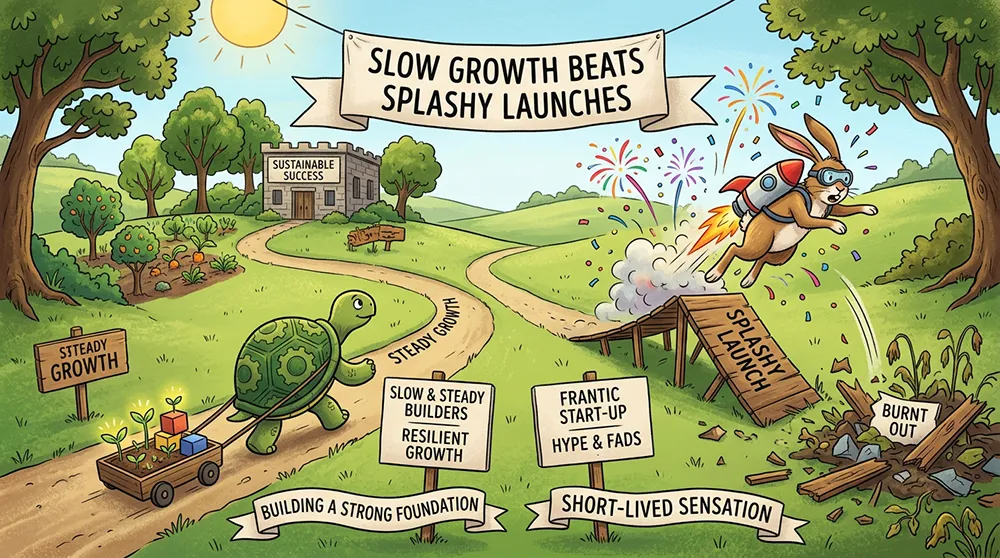
Now a strong opinion, delivered bluntly: steady slow growth beats skyrocketing launches every single time. Not because the launches don’t work. Because the launches don’t last.
Six-figure launch weeks are real. Genuine revenue. The Instagram celebration posts, the screenshots, the Stripe dashboard glamour shots. And then twelve weeks later, the launch is over, the funnel has burned through the audience, and revenue craters. The pressure to launch again is enormous. So they launch again. The audience is smaller this time, more skeptical, more launch-fatigued. The second launch does half as much as the first. The third does a quarter. The fourth doesn’t happen because, by then, the brand has quietly dissolved.
This is how many online businesses fail in slow motion. Not in one dramatic crash. In a series of weakening returns from a launch playbook that worked once and never recovered, until the founder quietly walks away from a business that used to look like a winner. If you can learn to focus on the right tasks at the right time, you greatly increase your probability of success.
A profitable online business that lasts looks different. It looks like a piece of content written three years ago that still brings in customers every week. It looks like an email list that grows by 50 people every week for two years, then quietly turns into 5,000 buyers. It looks like an affiliate marketing setup with 30 honest reviews of products you actually use, earning commissions in your sleep, with the occasional update.
That’s boring. That’s the point.
Boring and predictable is what you build on top of. Dramatic and binge-and-purge is what you can’t.
The SEO Shift Most Solopreneurs Should Make
If you’re stuck at $2K a month and you want to break out, the highest-leverage activity available to a solopreneur right now is still Search Engine Optimization. Not because it’s easy. Because it’s slow, and most of your competition is too impatient to do the work.
Social media gives you a hit today and nothing tomorrow. Paid ads give you a customer for $40, and you have to spend $40 again to get the next one. SEO gives you a piece of content that ranks for years and brings you a customer every day with zero ongoing spend.
Picture what this looks like in practice. A solopreneur in a niche like personal finance is at $2,400 a month, mostly from a small course and a tiny Patreon. She’s burning out posting to Instagram and TikTok daily. She makes one decision: stop posting to social for 60 days. She takes the time she saved (around 15 hours a week) and puts every hour into long-form content targeting specific keywords her audience is actually searching for. She picks 24 long-tail keywords. She writes one deeply useful article per week, around 2,500 words each, with affiliate marketing links woven in for products she genuinely recommends.
Twelve months later, she has 24 articles. Eight of them rank on page one of Google. Her monthly revenue is around $11,000, with roughly $7,000 of that coming from affiliate commissions on those eight articles. She’s working about 20 hours a week. She hasn’t posted to social in almost a year.
That isn’t a fantasy outcome. It’s a typical result for someone who actually does the work and follows a boring checklist for each blog post they write. The articles compound. They keep earning long after they’re written. That’s leverage. That’s what working ON the business produces. And it’s available to you right now if you’ll trade the dopamine of daily posting for the patience of writing things that compound.

Building Leverage Into What You Already Have
You don’t have to start over to do this. You shouldn’t.
Look at what you already have. The course. The coaching offer. The newsletter. The product. There’s almost certainly more leverage available inside it than has been pulled out so far.
Three places to look.
Existing content. If you’ve been blogging, podcasting, or making videos for a year, you have raw material. Some of it is targeting keywords people are actually searching for, and you don’t know it. Run your existing content through a free keyword tool. Find the three pieces with the most search potential and rebuild them as actual SEO assets. One afternoon of work can turn a forgotten post into a long-term traffic source.
Existing customers. The cheapest revenue you’ll ever earn comes from someone who already paid you once. Most early entrepreneurs ignore this entirely because they’re chasing new audiences instead. Build something for the people who already bought. A higher tier. An ongoing membership. A done-for-you version of the thing you taught them to do themselves. The $2K-a-month problem is often a $5K-a-month solution if existing customers are simply offered something more.
Existing time. The product that scales is one where every hour put in produces revenue forever, not just today. A live coaching call done once and never sold again is the worst case. A pre-recorded course is better. An evergreen article that earns affiliate commissions for three years is better still. Look at every hour of your week and ask whether it’s compounding or evaporating.
What’s Hard About Search Engine Optimization
Time for a real moment of honesty, because everything written so far sounds reasonable on the page and is genuinely hard in practice.
The hardest part of moving from working IN your business to working ON it is that the new work doesn’t pay you for a long time. Spending three weeks on a long-form SEO piece earns nothing for six months. Bills don’t pause for six months. The temptation to go back to the daily grind that produces today’s $80 is overwhelming, and most people give in to it more than once before they trust the slow stuff.
The second hard part is identity. If you’ve spent two years thinking of yourself as the daily content creator, becoming someone who writes one article a week and ignores Instagram feels like losing something. It isn’t. It’s becoming someone who runs a profitable online business, rather than someone who performs one.
The third hard part is that no one will clap for you while you do this work. The dopamine in entrepreneurship comes from launches, viral posts, and screenshots. The work that builds a durable business is invisible. You’ll write the article. Nobody will see it for months. You’ll feel like nothing is happening. That feeling is wrong, but you have to push through it on faith for a while before you’ve earned the proof.
Push through it anyway.

Why Paid Ads Aren’t the Answer at $2K/Month
A quick word, because somebody reading this is going to say, “Or you could just run ads to scale faster.”
I push back hard on the idea that early-stage solopreneurs should spend a fortune on paid advertising before they’ve built something sustainable. Paid ads amplify what you have. If what you have is a leaky funnel, a confused offer, and a product people don’t quite love, paid ads turn $2,000 of savings into $0 of savings and a slightly bigger email list of people who didn’t buy. This is one of the most common ways online businesses fail before they ever reach year three: the founder pours hard-earned savings into paid traffic before the underlying business is ready to convert it.
If you’re at $2K a month, your bottleneck is almost never traffic. Your bottleneck is leverage. Fix the leverage first. Pour gasoline on a working machine, never on a damp pile of sticks.
Time to Hit the Trail
If you take one thing from this post, take this. Your $2,000-a-month plateau is not a sign that your business is failing. It’s a sign you’ve hit the ceiling of what you can produce with your own two hands, in real time, every day. Year two is the wall where that strategy stops working. Year three is on the other side, but only if you change what you’re doing now.
Stop adding more hours. Start removing the hours that don’t compound.
Pick one piece of long-form, search-engine-friendly content this week. Write it for the person typing your topic into Google, not for the algorithm of a platform you don’t own. Add affiliate marketing links where they’re genuinely useful. Publish it. Then do the same thing next week.
Twelve months from now, you’ll have something nobody can take from you. A profitable online business built on leverage instead of labor. An asset, not a job. Sometimes the smallest, least dramatic decision (write the article instead of the social media post) is the one with the largest long-term payoff.
Time to hit the trail. The work is right in front of you.